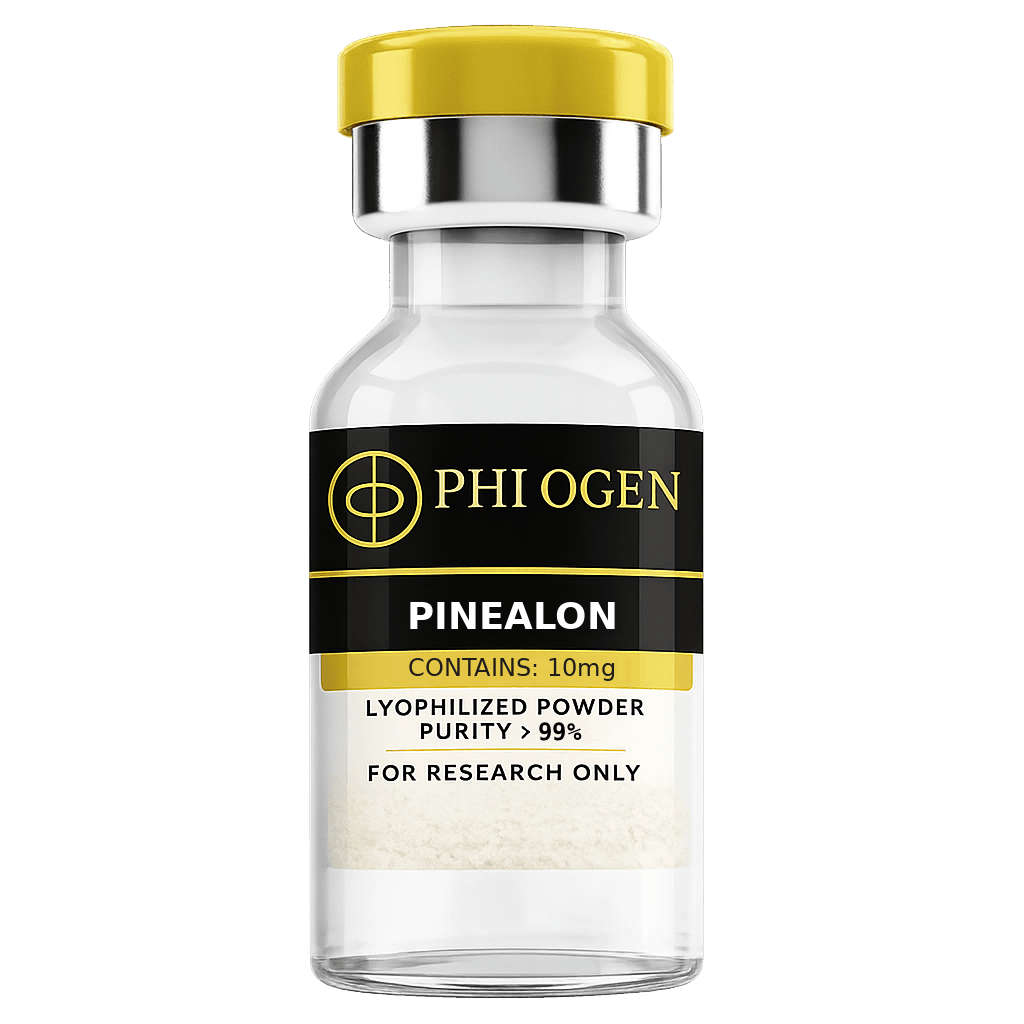
Pinealon 10mg
Nootropic research compound for cognitive studies.
Pinealon is a short peptide (Glu-Asp-Arg) in the Khavinson bioregulator class, studied primarily for effects on neurological function and aging. It belongs to the broader Russian peptide-bioregulator research tradition.
Proposed mechanism
The Khavinson peptides are hypothesized to exert tissue-specific effects by binding short DNA motifs and modulating gene expression in tissues matching their peptide origin. Pinealon research focuses on pineal- and brain-tissue-relevant endpoints.
Research highlights
- Tripeptide in the Khavinson bioregulator class
- Studied in neurological and aging research
- Short pulsed courses are the standard research protocol
- Decades of Russian literature behind the compound
Research protocol notes
Short pulsed research courses (10–20 days) are standard, consistent with other Khavinson peptides.
Stacking and comparative studies
Often studied alongside Epitalon and other Khavinson-class peptides.
Handling and storage
Lyophilized powder is stable at ambient shipping temperatures. Once reconstituted with bacteriostatic water, store at 2–8 °C and use within 28 days. For long-term storage of unreconstituted vials, freeze at −20 °C and protect from light.
Frequently asked
What is a Khavinson peptide?
A class of short peptides (usually 2–4 residues) developed by Prof. Vladimir Khavinson for tissue-specific bioregulatory research. Pinealon, Epitalon, and many of the "-gen" series peptides belong to this family.
What is the "short DNA motif" hypothesis?
A mechanistic proposal that short peptides can enter cells and bind specific DNA sequences, modulating gene expression in a tissue-specific way.
Why short pulsed courses?
The research tradition uses 10–20 day cycles rather than continuous dosing, consistent with the bioregulator framework.
What is the difference between 10 mg and 20 mg vials?
Total mass per vial. Choose based on study duration and concentration requirements.