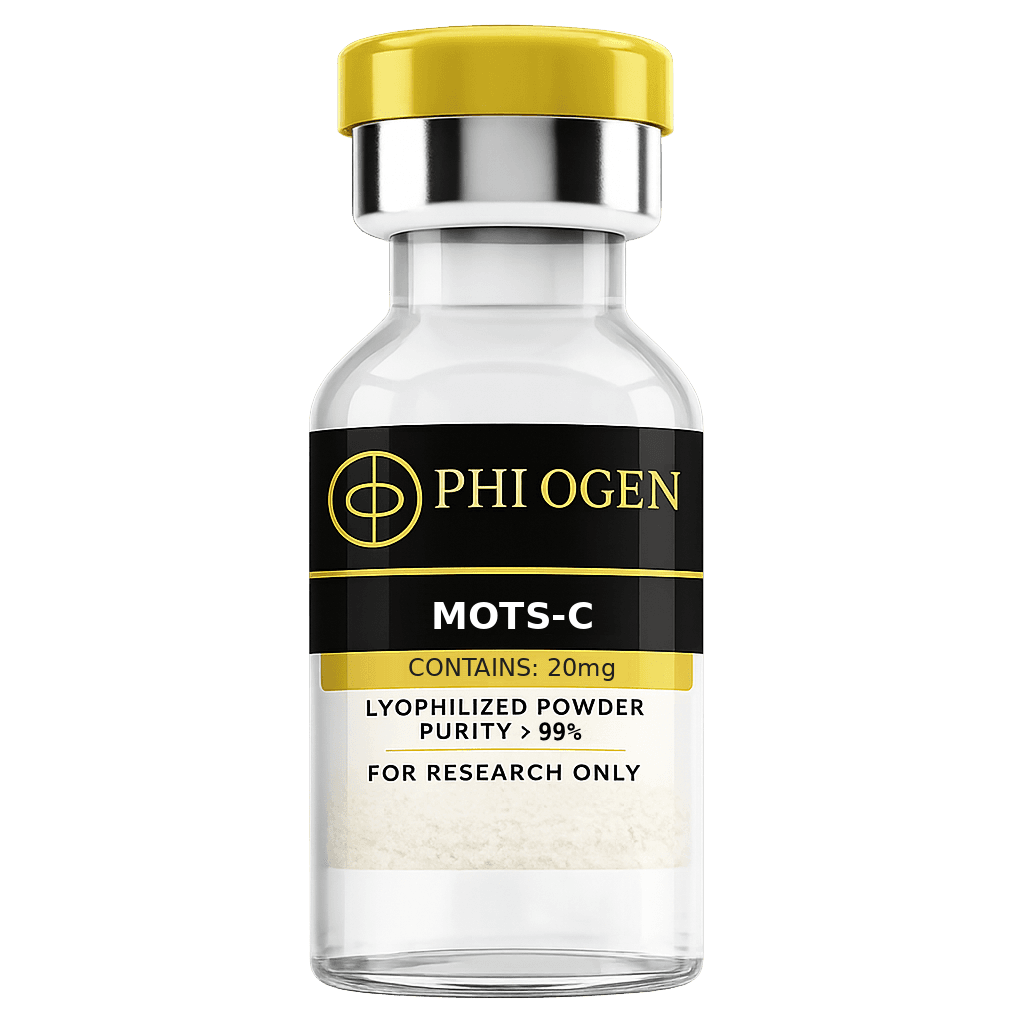
MOTS-c 20mg
Investigational support for tissue-repair research.
MOTS-c is a 16-amino-acid mitochondrial-derived peptide encoded in the 12S rRNA region of the mitochondrial genome. It is one of the most interesting entries in the "mitokine" class — peptides produced by mitochondria that signal metabolic state to the rest of the cell.
Proposed mechanism
MOTS-c modulates AMPK signaling and has been studied as a regulator of insulin sensitivity, glucose homeostasis, and exercise-response biology. Research describes it translocating to the nucleus under metabolic stress to regulate gene expression.
Research highlights
- Mitochondrial-derived peptide (a "mitokine")
- Encoded within the 12S rRNA region of mtDNA
- Studied in insulin-sensitivity, exercise, and longevity models
- Available in 10, 20, and 40 mg research vials
Research protocol notes
Research protocols typically use multi-weekly injection schedules. Reconstitute in BAC water; 20 mg vial in 2 mL yields 10 mg/mL stock.
Stacking and comparative studies
MOTS-c is frequently paired with NAD+ and SS-31 in mitochondrial-biology research stacks.
Handling and storage
Lyophilized powder is stable at ambient shipping temperatures. Once reconstituted with bacteriostatic water, store at 2–8 °C and use within 28 days. For long-term storage of unreconstituted vials, freeze at −20 °C and protect from light.
Frequently asked
What is a mitokine?
A signaling peptide produced by mitochondria — MOTS-c and humanin are the best-characterized members of this class.
How was MOTS-c discovered?
Through mining short ORFs in the mitochondrial genome — a 2015 paper from the Lee lab at USC put it on the research map.
What is its connection to exercise?
Research reports increased MOTS-c release during exercise and some evidence that exogenous administration mimics exercise-like metabolic endpoints.
Why multiple vial sizes?
Longer studies at higher concentrations use the 40 mg vial; shorter pilots use 10 mg.