
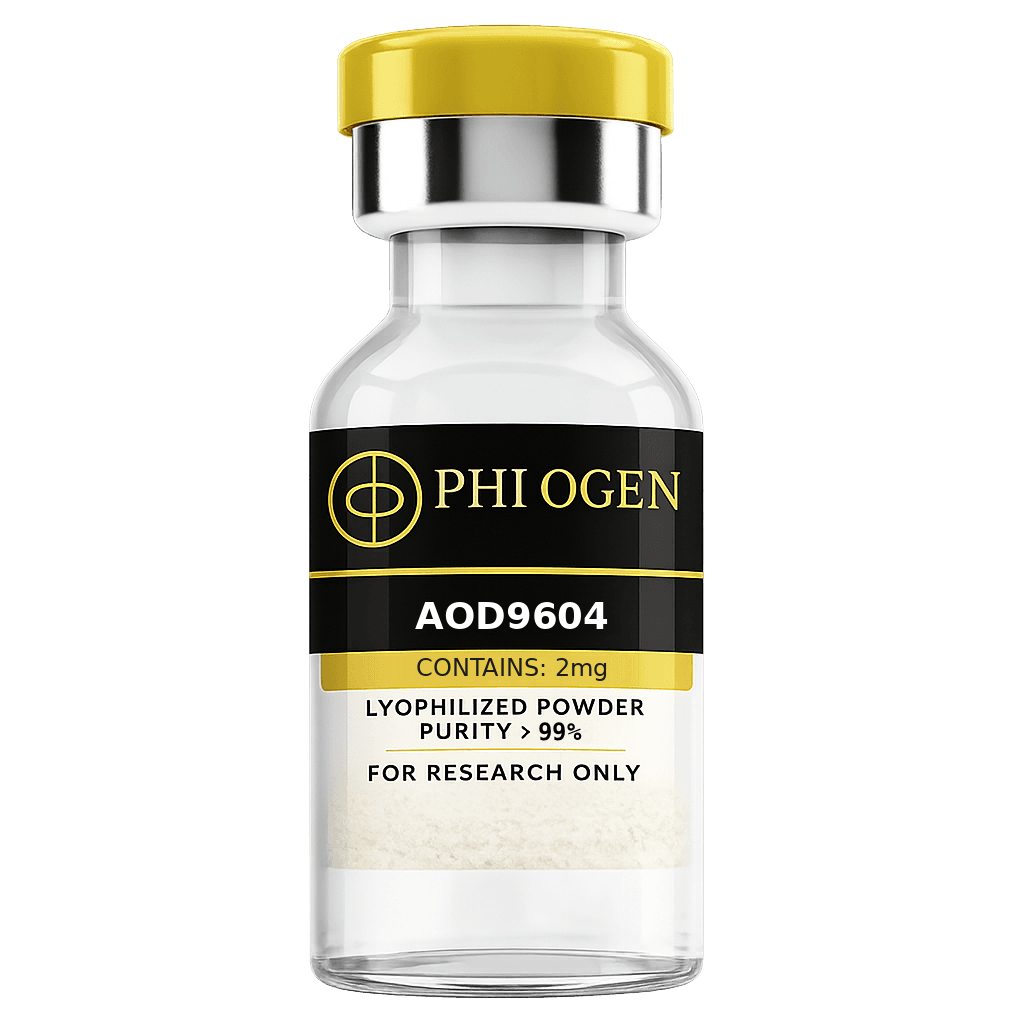
Buy AOD9604 Online — 3 sizes (2 mg–10 mg)
Incretin pathway research built around gastric-emptying and satiety endpoints.
AOD9604 is a synthetic fragment of the human growth hormone (residues 176–191), engineered to retain the lipolytic activity of GH without its growth-promoting effects. It is studied primarily in fat-metabolism research.
Vial sizes and price per mg
Up to 40% cheaper per mgReconstitution volumes
Volumes of bacteriostatic water required to dissolve each vial at common research concentrations.
| Vial | at 2 mg/mL | at 5 mg/mL | at 10 mg/mL |
|---|---|---|---|
| 2 mg | 1 mL | 0.40 mL | 0.20 mL |
| 5 mg | 2.50 mL | 1 mL | 0.50 mL |
| 10 mg | 5 mL | 2 mL | 1 mL |
Numbers are calculated from the stated vial mass. Verify against the supplier's instructions for your specific research protocol.
Mechanism in the literature
AOD9604 is proposed to mimic the lipolytic tail region of GH, stimulating lipolysis and inhibiting lipogenesis in adipocytes without activating the full GH-receptor signaling cascade. This separation of effects is the engineering rationale.
Research use-cases
- Modified fragment of hGH 176–191
- Engineered to isolate lipolytic from growth-promoting effects
- Studied in adipocyte and body-composition research
- Multiple research vial sizes (2, 5, 10 mg)
Often paired with
Buyers viewing AOD9604 typically also consider SLU-PP-332 (Liquid), AICAR and Retatrutide. Each is in stock, sealed under nitrogen with a lot-matched CoA.
Handling in the lab
Reconstitute under sterile technique with bacteriostatic water. Typical volumes range from 1–3 mL depending on the target working concentration. Swirl gently — do not shake — to avoid peptide shearing.
Stacking and paired-compound work
Sometimes studied alongside other metabolic-research compounds.
Frequently asked
Is AOD9604 the same as growth hormone?
No — it is a small modified fragment corresponding to residues 176–191 of hGH. The fragment isolates lipolytic activity from the full GH signaling profile.
What does "AOD" stand for?
Anti-Obesity Drug — the original research designation when the compound was developed by Metabolic Pharmaceuticals.
Why multiple vial sizes?
Research concentration and duration vary. 2 mg for short pilots, 10 mg for longer protocols.
How does it compare to tirzepatide/semaglutide?
Different mechanism entirely — AOD9604 acts on adipocyte lipolysis; GLP-1-class compounds act on appetite and insulin signaling.
More Fat Loss compounds
 2 sizes-10%
 -10%
-10% 2 sizes-10%
 2 sizes-10%