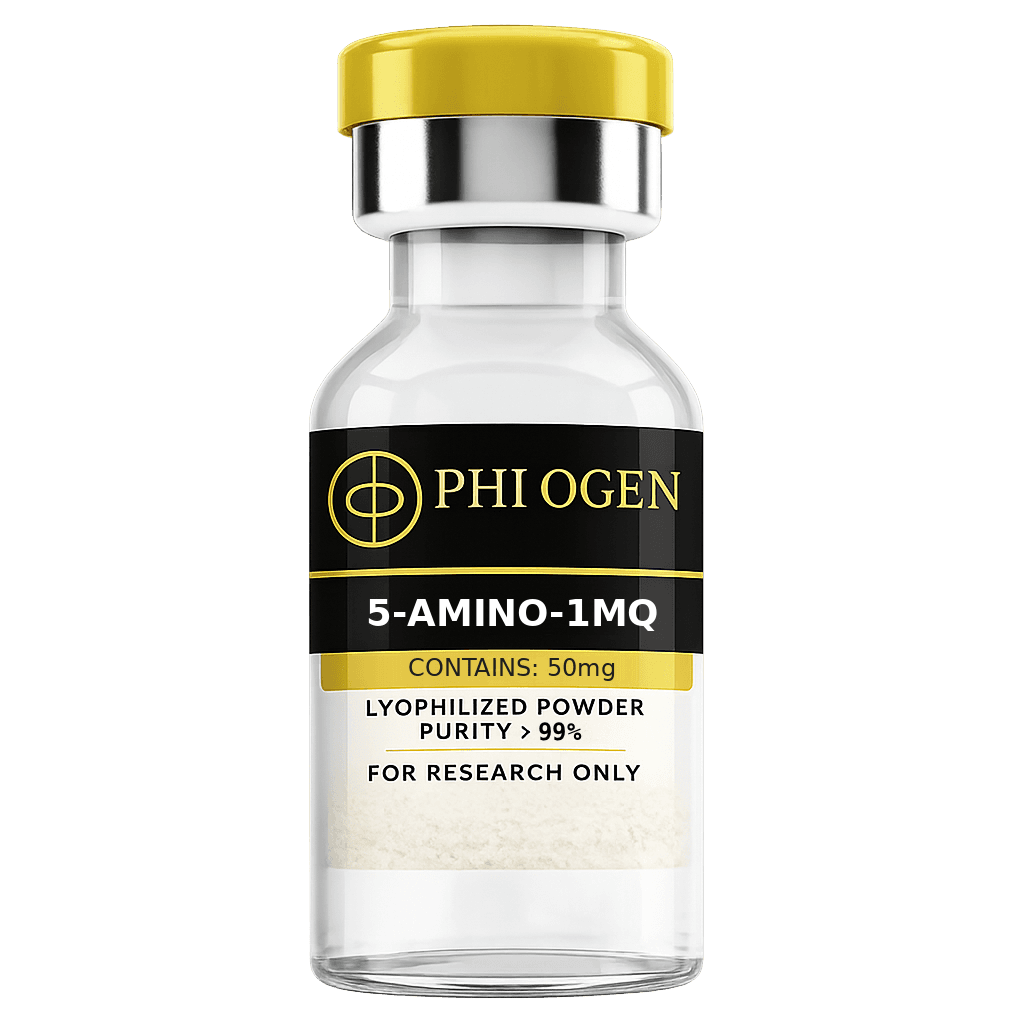
5-Amino-1MQ 50mg
Metabolic support for body recomposition research.
5-Amino-1MQ is a small-molecule inhibitor of NNMT (nicotinamide N-methyltransferase), an enzyme central to NAD+ salvage and methyl-donor balance. It is actively studied in obesity, metabolic, and sarcopenia research.
Proposed mechanism
NNMT consumes both nicotinamide (an NAD+ precursor) and SAM (the universal methyl donor). Inhibiting NNMT raises nicotinamide availability for NAD+ synthesis and preserves SAM pools — a mechanism proposed to support both metabolic and muscle-biology endpoints.
Research highlights
- NNMT inhibitor — small molecule, not a peptide
- Raises NAD+ precursor availability via NNMT blockade
- Studied in adipocyte, muscle, and metabolic research
- Available in oral capsule and injectable research formats
Research protocol notes
Both oral and injectable research routes appear in the literature. Oral capsule formats are convenient for multi-week protocols.
Stacking and comparative studies
Comparative protocols sometimes combine 5-Amino-1MQ with direct NAD+ supplementation to study combined NNMT-blockade and NAD+-repletion effects.
Handling and storage
Lyophilized powder is stable at ambient shipping temperatures. Once reconstituted with bacteriostatic water, store at 2–8 °C and use within 28 days. For long-term storage of unreconstituted vials, freeze at −20 °C and protect from light.
Frequently asked
Is 5-Amino-1MQ a peptide?
No — it is a small-molecule NNMT inhibitor (a quinoline derivative), not a peptide. It appears in peptide-research catalogs because it targets NAD+-adjacent biology.
What is NNMT?
Nicotinamide N-methyltransferase — an enzyme that consumes nicotinamide and SAM to produce N-methylnicotinamide. Elevated NNMT activity is linked to obesity in research models.
Oral or injectable?
Both formats are used. Oral capsules suit longer research windows; injectable is used when fast PK is desired.
How does it interact with NAD+ supplementation?
NNMT blockade increases the nicotinamide pool available for NAD+ synthesis — a complementary mechanism to direct NAD+/NMN supplementation.