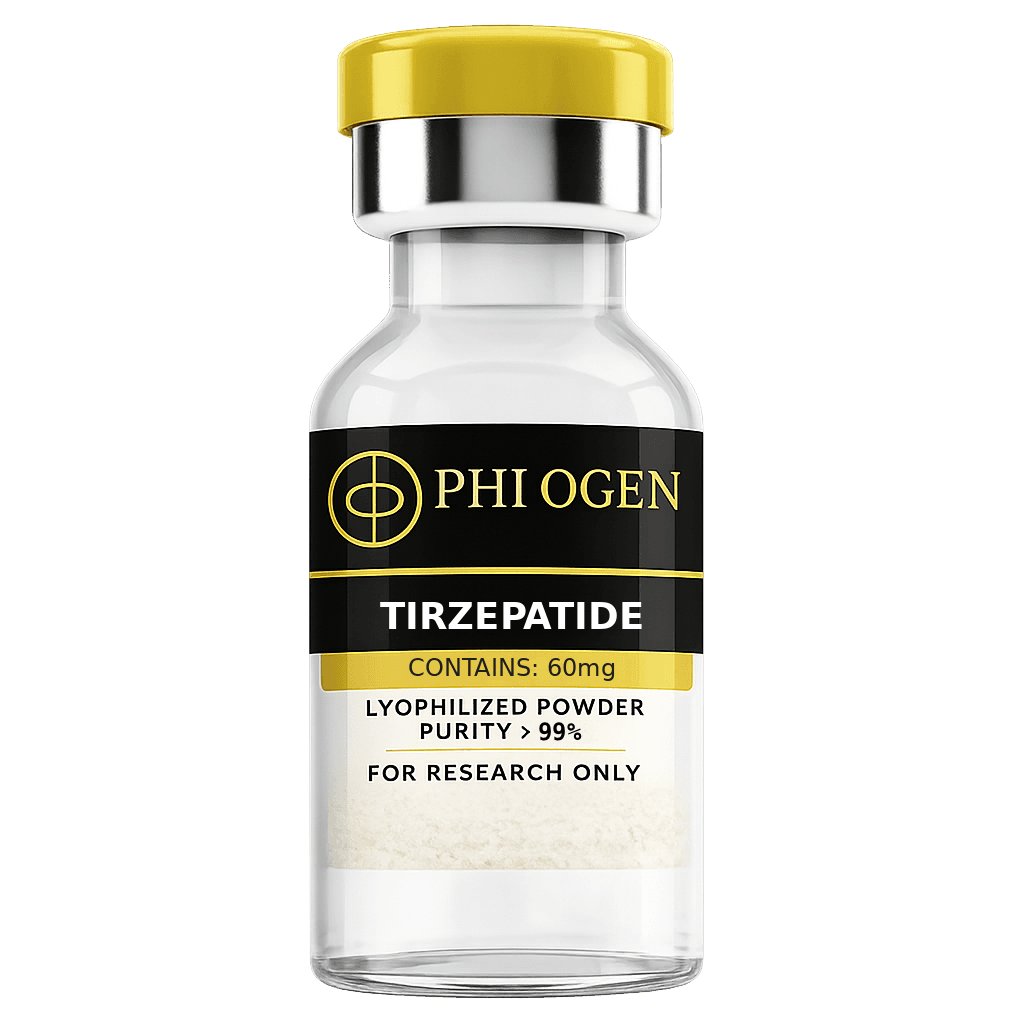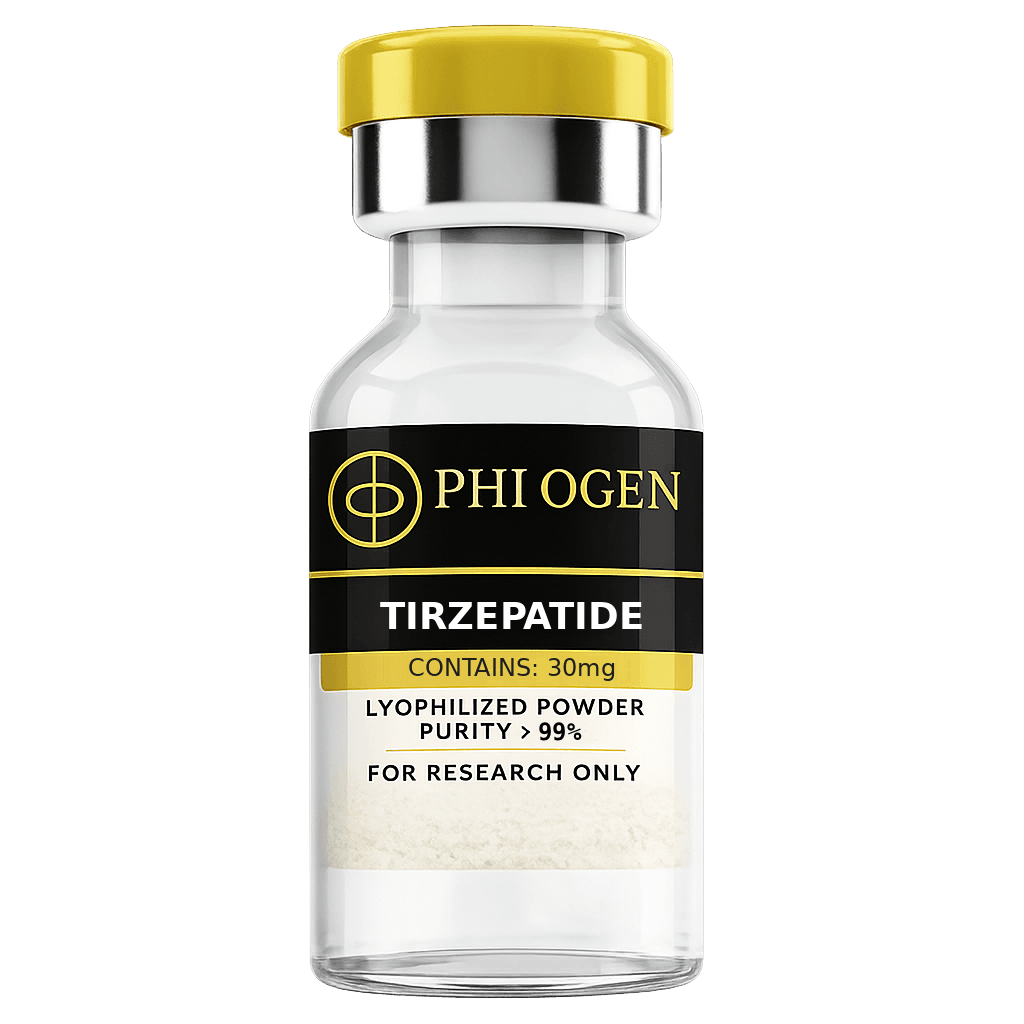
Tirzepatide 30mg
Metabolic support for body recomposition research.
Tirzepatide is a synthetic dual agonist of the GIP and GLP-1 receptors — two incretin pathways that collaborate in glucose and energy-balance regulation. Research interest centers on whether dual agonism produces additive or synergistic effects compared with GLP-1-only compounds such as semaglutide.
Proposed mechanism
Unlike pure GLP-1 agonists, tirzepatide activates both the GIP (glucose-dependent insulinotropic polypeptide) receptor and the GLP-1 receptor. GIP signaling contributes to insulin release and adipocyte function; the combination is theorized to drive stronger metabolic endpoints at lower GLP-1-driven GI burden.
Research highlights
- Dual GIP/GLP-1 receptor agonist — a class distinct from semaglutide
- Weekly-dosing research profile, typically studied over 12–40 week windows
- Frequently benchmarked against semaglutide and retatrutide
- Available in 15, 30, and 60 mg research vial sizes
Research protocol notes
Research protocols commonly titrate from low to target concentrations over 4–8 weeks. Reconstitute in bacteriostatic water; a 30 mg vial in 3 mL BAC water yields 10 mg/mL working stock. Aliquot to limit freeze-thaw cycles.
Stacking and comparative studies
Tirzepatide is usually studied alone in head-to-head comparisons with other incretin compounds. Stacking with cagrilintide or with fat-loss-adjacent compounds like 5-Amino-1MQ appears in some comparative protocols.
Handling and storage
Lyophilized powder is stable at ambient shipping temperatures. Once reconstituted with bacteriostatic water, store at 2–8 °C and use within 28 days. For long-term storage of unreconstituted vials, freeze at −20 °C and protect from light.
Frequently asked
How does tirzepatide differ from semaglutide?
Tirzepatide activates both the GIP and GLP-1 receptors; semaglutide activates only GLP-1. Research studies report stronger metabolic endpoints for tirzepatide in many models.
Why are there 15, 30, and 60 mg vial sizes?
Larger vials reduce per-mg cost for longer studies; smaller sizes suit pilot and titration work.
Is tirzepatide the same as Mounjaro or Zepbound?
Those are commercial pharmaceutical formulations. The material sold here is research-grade and not for human use.
What is a typical reconstitution?
Common research dilutions use 1–3 mL of bacteriostatic water per vial. Aliquot before freezing to reduce freeze-thaw stress.