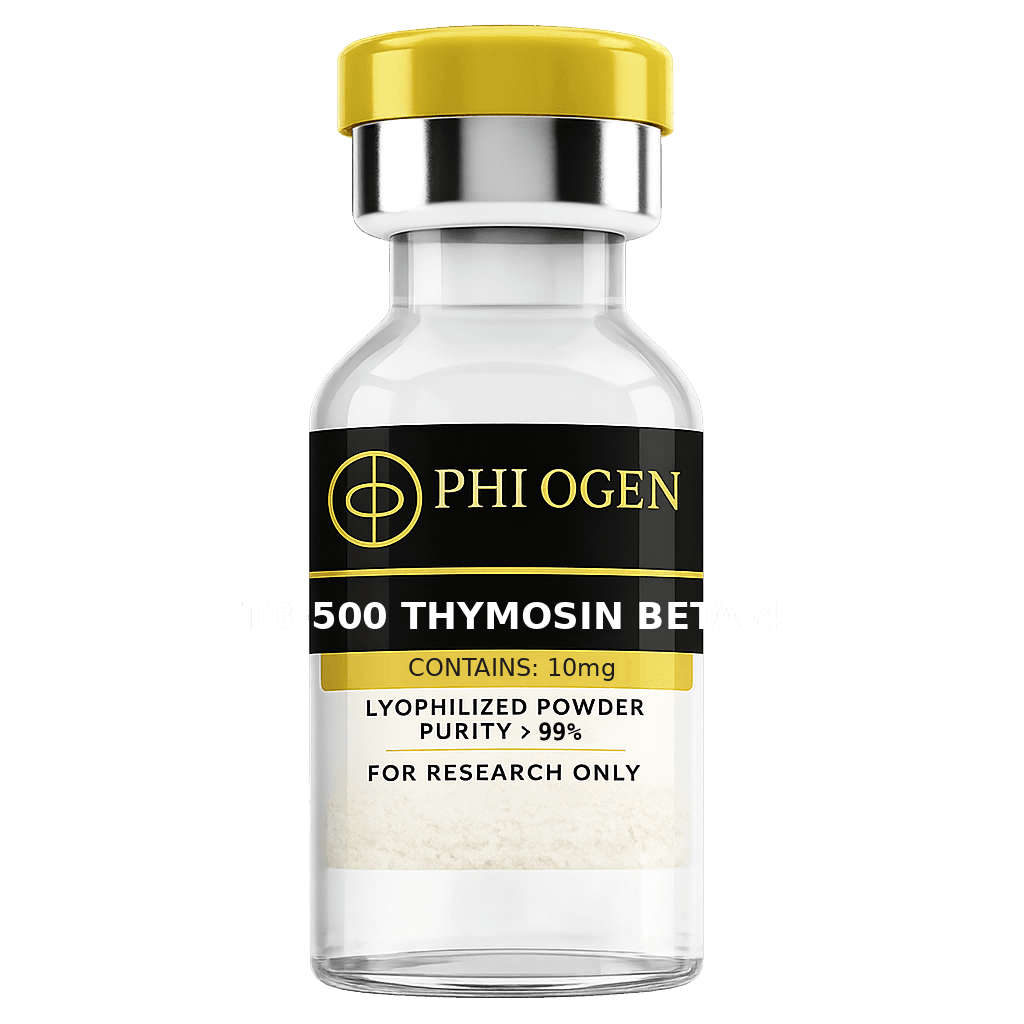
Buy TB-500 (Thymosin Beta-4) — 10 mg Lyophilized Vial
Mapped to cytokine modulation in injury research — regenerative-signalling work.
TB-500 is a synthetic fragment of Thymosin Beta-4, a naturally occurring 43-amino-acid peptide present at high concentrations in platelets and wound fluid. Research interest in TB-500 centers on its role in actin sequestration and cellular migration, which underpins its frequent appearance in tissue-repair and cardiovascular models.
Reconstitution volumes
Volumes of bacteriostatic water required to dissolve each vial at common research concentrations.
| Vial | at 2 mg/mL | at 5 mg/mL | at 10 mg/mL |
|---|---|---|---|
| 10 mg | 5 mL | 2 mL | 1 mL |
Numbers are calculated from the stated vial mass. Verify against the supplier's instructions for your specific research protocol.
Key facts
- Derived from Thymosin Beta-4, one of the most abundant intracellular proteins
- Studied in models of dermal wound healing, cardiac remodeling, and corneal repair
- Frequently paired with BPC-157 in repair-comparison protocols
- Reported half-life in circulation is longer than most research peptides — days rather than hours
Mechanism in the literature
Thymosin Beta-4 binds and sequesters G-actin monomers, regulating the dynamic actin pool available for cytoskeletal remodeling. This is the proposed basis for its effects on cell migration, wound closure, and the recruitment of progenitor cells to sites of injury in animal models.
Often paired with
Buyers viewing TB-500 (Thymosin Beta-4) typically also consider Bronchogen, Thymosin Alpha-1 and Cardiogen. Each is in stock, sealed under nitrogen with a lot-matched CoA.
Research use-cases
- Derived from Thymosin Beta-4, one of the most abundant intracellular proteins
- Studied in models of dermal wound healing, cardiac remodeling, and corneal repair
- Frequently paired with BPC-157 in repair-comparison protocols
- Reported half-life in circulation is longer than most research peptides — days rather than hours
Handling in the lab
Rodent studies commonly use 2–10 mg/kg administered 1–3× weekly. A 10 mg vial reconstituted in 2 mL BAC water yields 5 mg/mL. Use sterile technique and aliquot to minimize freeze-thaw exposure.
Stacking and paired-compound work
BPC-157 + TB-500 is the most common blend in the literature — the two peptides address different arms of the repair response. Pre-mixed stacks are available to simplify multi-peptide research designs.
Storage and shelf-life
Lyophilized powder is stable at ambient shipping temperatures. Once reconstituted with bacteriostatic water, store at 2–8 °C and use within 28 days. For long-term storage of unreconstituted vials, freeze at −20 °C and protect from light.
Frequently asked
Is TB-500 the same as Thymosin Beta-4?
TB-500 is an active fragment of the full 43-residue Thymosin Beta-4 peptide, containing the actin-binding sequence. They are used somewhat interchangeably in research but TB-500 is the synthetic form most labs work with.
What is its proposed mechanism?
G-actin sequestration — binding free actin monomers and regulating the cytoskeletal pool that drives cell migration and tissue remodeling.
Why stack it with BPC-157?
They hit different repair pathways. Comparative studies report additive outcomes in some soft-tissue models.
How should TB-500 be stored after reconstitution?
2–8 °C for up to 28 days. Never re-freeze a reconstituted solution.