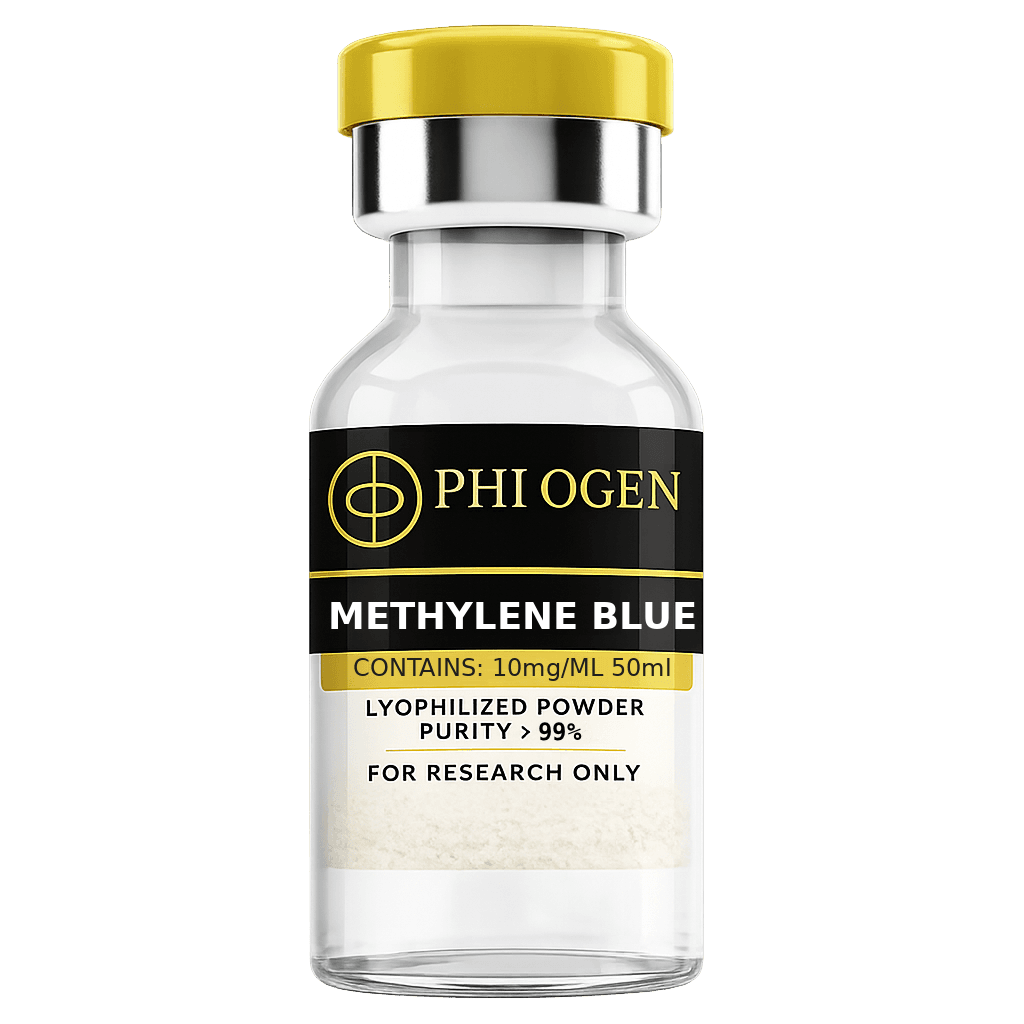
Buy Methylene Blue (Liquid) — Pre-Dissolved 10 mg/mL · 50 mL Bottle
Anti-ageing pathway work examining systemic inflammation-of-ageing markers.
Methylene blue is a phenothiazine-derived compound with a long history in both biomedical research and as a redox indicator. It is studied in mitochondrial, neurological, and antimicrobial-adjacent research contexts.
Bottle breakdown and $/mL
Pre-mixed at the supplier's facility. Each bottle ships sealed, no reconstitution step required.
- Concentration
- 10 mg/mL
- Volume
- 50 mL
- Total active
- 500 mg
- Price
- $53.99
- $ per mL
- $1.08
Mechanism in the literature
At low concentrations, methylene blue acts as an alternative electron carrier in the mitochondrial electron-transport chain, bypassing certain complex dysfunctions. At higher concentrations, its redox cycling can generate oxidative stress — the biphasic profile is central to dose-design in research.
Often paired with
Buyers viewing Methylene Blue (Liquid) typically also consider PT-141, GHK-Cu and SNAP-8. Each is in stock, sealed under nitrogen with a lot-matched CoA.
Research use-cases
- Phenothiazine-derived small molecule
- Biphasic redox profile (low-dose vs high-dose research)
- Studied in mitochondrial and neurological models
- 50 mL bottle at 10 mg/mL research concentration
Handling in the lab
Research protocols emphasize dose-dependent effects. Low concentrations are used in mitochondrial-support studies; higher concentrations appear in antimicrobial and redox-stress research.
Storage and shelf-life
Lyophilized powder is stable at ambient shipping temperatures. Once reconstituted with bacteriostatic water, store at 2–8 °C and use within 28 days. For long-term storage of unreconstituted vials, freeze at −20 °C and protect from light.
Key facts
- Phenothiazine-derived small molecule
- Biphasic redox profile (low-dose vs high-dose research)
- Studied in mitochondrial and neurological models
- 50 mL bottle at 10 mg/mL research concentration
Frequently asked
Is methylene blue a peptide?
No — it is a small-molecule phenothiazine derivative. It appears in peptide-research catalogs because of its mitochondrial-research applications.
What is the biphasic dose profile?
Low concentrations support electron transport; high concentrations drive redox cycling and oxidative stress. Dose selection is critical in research design.
What mitochondrial research uses methylene blue?
Complex I/IV dysfunction models, neurodegeneration research, and ischemic-stress protocols.
Why research-grade matters?
Pharmaceutical-grade methylene blue is engineered for purity and low zinc/chromium contamination — research-grade versions are tested to similar standards.