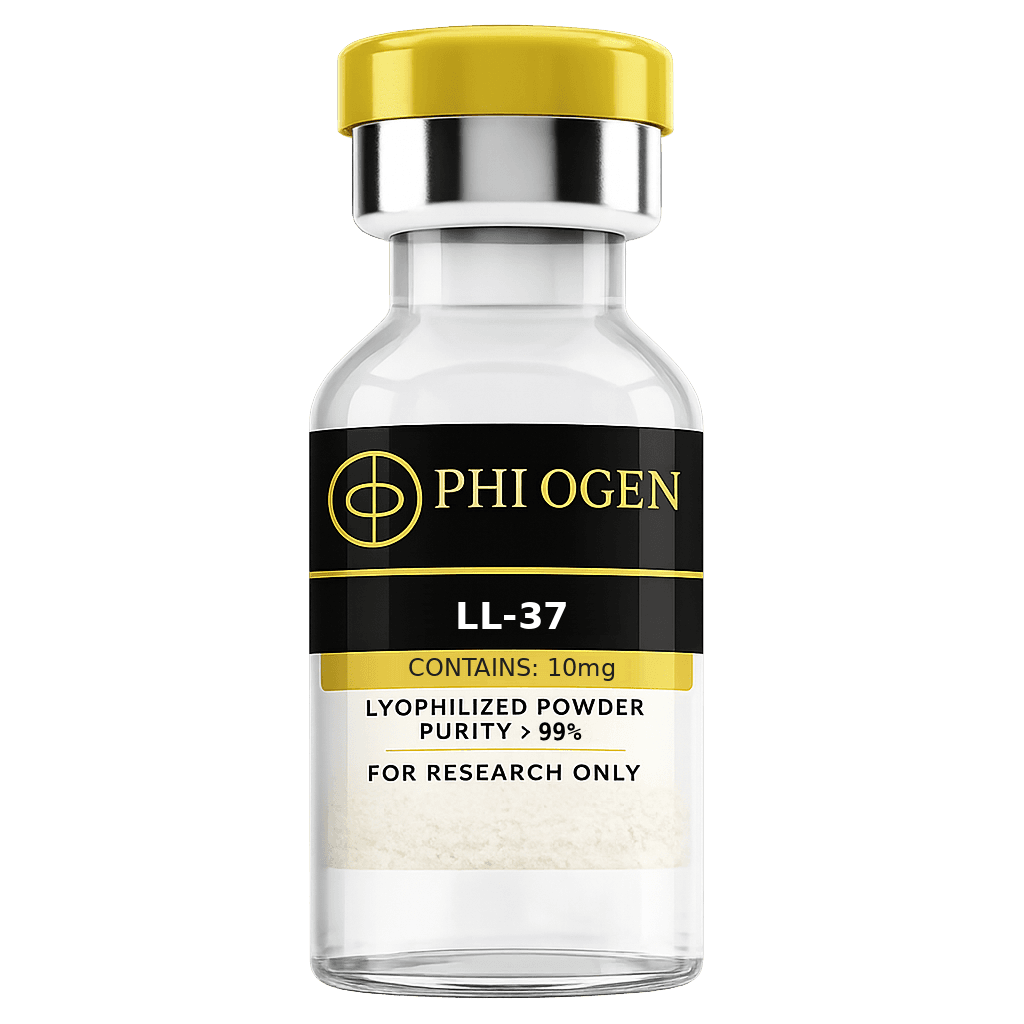
Buy LL-37 — 10 mg Lyophilized Vial
Structured around mucosal and gut-barrier models — tendon and ligament studies.
LL-37 (cathelicidin-derived) is a 37-amino-acid human antimicrobial peptide and a central member of the innate-immunity peptide family. It is studied across antimicrobial, immunomodulatory, and wound-repair research contexts.
Reconstitution volumes
Volumes of bacteriostatic water required to dissolve each vial at common research concentrations.
| Vial | at 2 mg/mL | at 5 mg/mL | at 10 mg/mL |
|---|---|---|---|
| 10 mg | 5 mL | 2 mL | 1 mL |
Numbers are calculated from the stated vial mass. Verify against the supplier's instructions for your specific research protocol.
Key facts
- Only human cathelicidin-derived antimicrobial peptide
- Broad-spectrum antimicrobial activity in vitro
- Simultaneously immunomodulatory
- Central entry in innate-immunity peptide research
Mechanism in the literature
LL-37 has direct antimicrobial activity against a broad spectrum of bacteria, fungi, and viruses. It also modulates host immune signaling — chemotaxis, cytokine release, and epithelial repair are all within its documented activity profile.
Often paired with
Buyers viewing LL-37 typically also consider Bacteriostatic Water, BPC-157 and Thymogen. Each is in stock, sealed under nitrogen with a lot-matched CoA.
Research use-cases
- Only human cathelicidin-derived antimicrobial peptide
- Broad-spectrum antimicrobial activity in vitro
- Simultaneously immunomodulatory
- Central entry in innate-immunity peptide research
Handling in the lab
Reconstitute under sterile technique with bacteriostatic water. Typical volumes range from 1–3 mL depending on the target working concentration. Swirl gently — do not shake — to avoid peptide shearing.
Stacking and paired-compound work
Typically studied alone in antimicrobial research.
Storage and shelf-life
Lyophilized powder is stable at ambient shipping temperatures. Once reconstituted with bacteriostatic water, store at 2–8 °C and use within 28 days. For long-term storage of unreconstituted vials, freeze at −20 °C and protect from light.
Frequently asked
What is cathelicidin?
A family of antimicrobial peptide precursors. LL-37 is the only mature peptide derived from the human cathelicidin gene (CAMP).
What organisms has it been studied against?
Gram-positive and Gram-negative bacteria, mycobacteria, fungi, and some viruses. It is one of the most broadly active human AMPs.
Is LL-37 studied beyond antimicrobial research?
Yes — wound repair, inflammation modulation, and cancer-adjacent research all appear in the literature.
Why is it called LL-37?
The peptide starts with two leucines (LL) and is 37 residues long.