
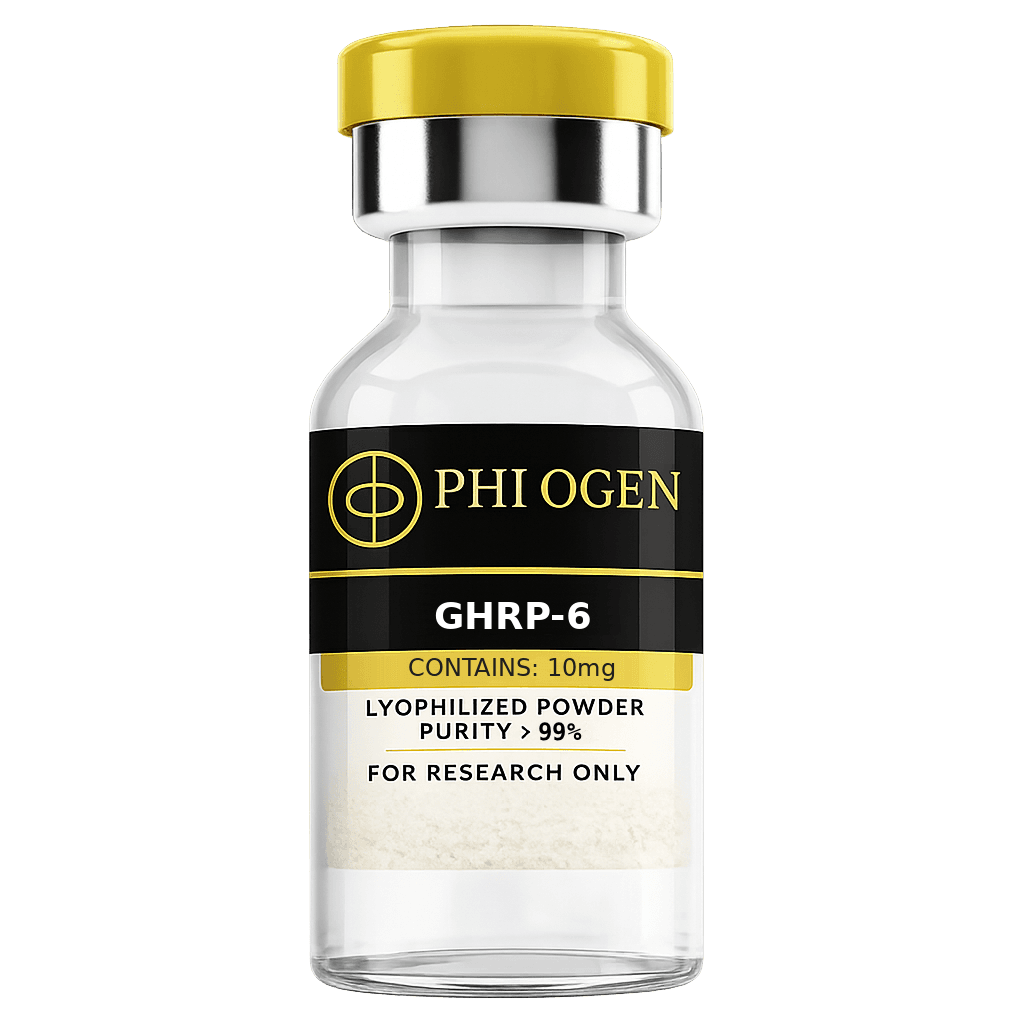
Buy GHRP-6 — 10 mg Lyophilized Vial
Focused on cross-compound potency mapping — somatotropic signalling work.
GHRP-6 is an early hexapeptide ghrelin-receptor agonist notable for its strong appetite-stimulatory profile in addition to GH release. It is a benchmark compound in both GH-secretagogue and ghrelin-pathway research.
Reconstitution volumes
Volumes of bacteriostatic water required to dissolve each vial at common research concentrations.
| Vial | at 2 mg/mL | at 5 mg/mL | at 10 mg/mL |
|---|---|---|---|
| 10 mg | 5 mL | 2 mL | 1 mL |
Numbers are calculated from the stated vial mass. Verify against the supplier's instructions for your specific research protocol.
Key facts
- Early hexapeptide GHRP
- Strong appetite-stimulation profile
- Well-documented benchmark compound
- Short half-life supports pulsed protocols
Mechanism in the literature
GHRP-6 is a potent ghrelin-receptor agonist driving both GH release and appetite signaling. Its appetite-stimulation endpoints are substantially stronger than other GHRPs — a feature used in some research contexts and avoided in others.
Often paired with
Buyers viewing GHRP-6 typically also consider PEG-MGF, GHRP-2 and Gonadorelin Acetate. Each is in stock, sealed under nitrogen with a lot-matched CoA.
Research use-cases
- Early hexapeptide GHRP
- Strong appetite-stimulation profile
- Well-documented benchmark compound
- Short half-life supports pulsed protocols
Handling in the lab
Reconstitute under sterile technique with bacteriostatic water. Typical volumes range from 1–3 mL depending on the target working concentration. Swirl gently — do not shake — to avoid peptide shearing.
Stacking and paired-compound work
Sometimes combined with GHRH analogs.
Storage and shelf-life
Lyophilized powder is stable at ambient shipping temperatures. Once reconstituted with bacteriostatic water, store at 2–8 °C and use within 28 days. For long-term storage of unreconstituted vials, freeze at −20 °C and protect from light.
Frequently asked
Why is GHRP-6 known for appetite effects?
Ghrelin is the primary appetite-stimulating hormone. GHRP-6 is a particularly strong ghrelin-receptor agonist, which is why appetite stimulation is prominent.
When would researchers choose GHRP-6 over ipamorelin?
Research contexts where appetite stimulation is an endpoint of interest, or comparative studies against the "cleaner" selective secretagogues.
What is the typical half-life?
Short — under an hour in research models.
Is it still widely used?
Less than in its 1990s–2000s peak, but still a benchmark in ghrelin-pathway literature.
More Growth compounds
 2 sizes-10%
 2 sizes-10%
 3 sizes-10%
 -10%
-10%